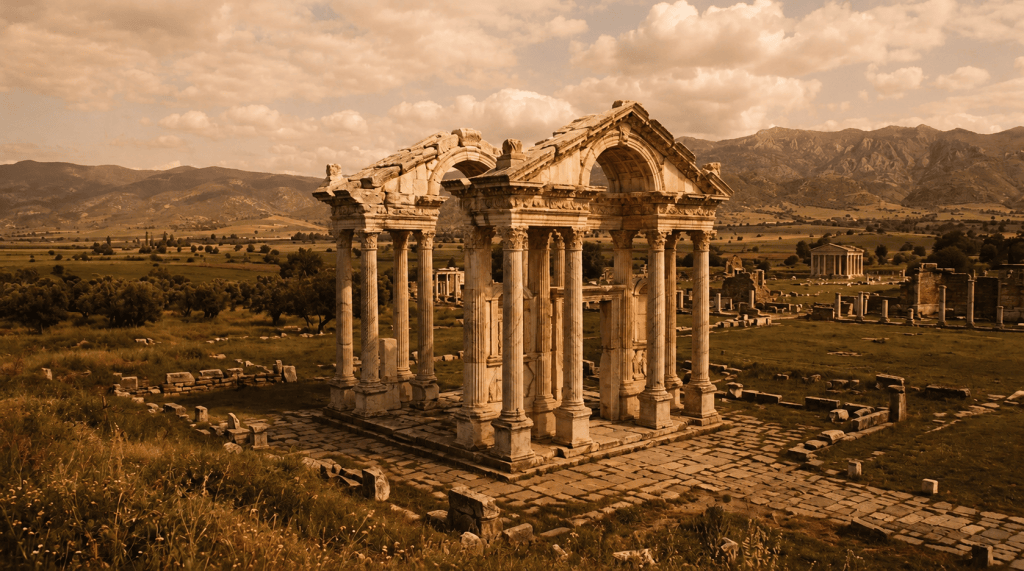
Building Ilion-Alašae
The Chronicles of Cymru began with three lines from the opening of Hanes Cymru, by John Davies:
“Once upon a time, the Welsh knew when their history began. It began about 1170 BC. That was when the Ark of the Covenant was captured by the Philistines and when Brutus, a descendant of the Trojans, landed on the shores of Britain…”
Despite being born and raised in Wales, I had never heard anything like it.
Like most people with an interest in archaeology and history, I was aware of The Iliad, The Ark of the Covenant, and the ancient civilizations of Greece and Rome that claimed descent from Troy through Aeneas. But the idea that the fall of Troy could be connected to the beginning of Welsh history was new to me. How could Troy have existed here, among the damp hillsides and small farms?
Within minutes I had disappeared down a research rabbit hole; and that research became the bones of Ilion-Alašae.
The Wales Brutus Would Have Found
Archaeological and paleoclimatic records reinforce the story in a way that surprised me. 1170 BC was a real period of upheaval and enormous environmental change. Starting around 1250 BC, and worsening after 1000 BC, rainfall was increasing, the summers were getting shorter, and peat was spreading across the the upland landscapes. Communities that had farmed the mountains of North Wales gradually abandoned many of their settlements as the land became increasingly difficult to cultivate. People moved towards the lower valleys and more productive grounds, leaving the uplands largely empty.
This abandonment of the Snowdon area fascinated me – and gave me a spark of plausibilty. If a group of refugees really had arrived from Troy during this period, they would have encountered an abandoned landscape. There would have been no invasion. Just a trickle of displaced farmers, and communities that had already thinned out or moved on.
The Journey from Troy to Britain
The real city of Troy was located in Hisarlık, in northwestern Anatolia, modern Türkiye, near the mouth of the Dardanelles – the narrow strait connecting the Aegean Sea to the Sea of Marmara. Once in the Aegean Sea, the route becomes geographically sound. Travellers could plausibly sail out past the Pillars of Hercules, and up the Atlantic coast – the same journey later claimed by Aeneas’s descendants in the Roman foundation myth. But according to Geoffrey of Monmouth, Brutus sailed past Italy and continued north, choosing to spend months on open water before finally reaching Britain. It would have been a brutal crossing – exactly the kind of ordeal that turns refugees into theancestors of legends.
The “Giants” of Britain
Geoffery of Monmouth claims that when Brutus arrived on the shores of Britain, it was inhabited by giants – Gogmagog and his kin, the last of a dwindling race. The presence of giants in Wales is further supported by the Mabinogion, where Brân the Blessed (Bendigeidfran in Welsh), is referred to as a giant so tall that he can wade across the Irish Sea, and so great in stature that no ship could carry him. When the Irish burned the bridge across the River Shannon, Bran lay across the river so that his men could march over, using his body as a bridge. Writing in the 12th century, Geoffrey almost certainly intended readers to understand that he was talking about actual legendary giants, on par with the Nephilim in Genesis, the Fomorians in Irish tradition, and half the “giant” races scattered through medieval legend. However, I didn’t want to write a story about giants. I wanted to write a story about people. And as an anthropologist, I was well aware of the way people create differences and justify displacement. It tends to appear whenever one culture is measuring itself against another and seeking to establish a clear and separate identity.
Imagine the traumatized survivors of a genuinely sophisticated eastern Mediterranean civilization, washing up on the shores of small tribal Bronze Age communities whose technology, education, architecture and seemed primitive in comparison.
Over centuries, the memory of uncivilized, crude and brutish people might simply be transformed into stories about giants – which is an easy reach when one considers the Cyclops, Polyphemus, who Ulysses was said to encounter on his way back to Ithaca from Troy. Polyphemus, like many of the Welsh farmers would have been, was a shepherd.
Ilion-by-the-Sea
The city’s name was my next challenge.
The language of ancient Troy is lost. But in Ancient Greek, Troy was referred to as Ilion, which is a word that looks plausibly Welsh to any Welsh speaker. We have the boys’ name Llion, which is also a poetic term for streams, floods, or flowing waters.
I loved the name “Ilion.” But I needed something more; something that would mark this as “their” Troy, built in exile.
Inspiration struck when I visited the California city, Cardiff-by-the-Sea.
Cardiff is the capital of Wales.
Instantly I could imagine it – a city in the uplands of Snowdonia, founded by sailors who had spend brutal and unpleasant months on the ocean’s tides.
Ilion-by-the-Sea.
As noted, the language of Troy is essentially lost, so I dove into the languages of the Late Bronze Age – Egyptian, Hittite, Ugaritic, and Linear B texts – and found an ancient kingdom called Alašiya, that supplied most of the ancient Near East with copper – now generally identified as Cyprus. Alašiya wasn’t Troy, but it was exactly the kind of place the Trojans would have known: a coastal, sea-trading Bronze Age power, wealthy on maritime commerce, belonging to the same lost world that Troy belonged to.
I created the word Alašae to mean “by the sea” as a resonance of that city, invoking a real Bronze Age location that would have already reprsented a wealthy kingdom reached by water. Thus Ilion-Alašae became more than just “Ilion-by-the-Sea.” It became Ilion carrying the name of the kind of maritime power it aspired to become again.
The Pheryllt of Wales
If the displaced survivors of Troy understood the tribesmen of ancient Britain as “giants,” I needed to understand how the tribesmen viewed their strange invaders.
Thankfully, Welsh legend had just the thing.
The Pheryllt are part of Druid-revival tradition, mysterious figures associated with alchemy,metallurgy, and hidden wisdom. They were said to have kept their college at Dinas Affaraon, “the city of the higher powers,” also sometimes translated as “the city of pharaohs,” alluding again to a Near East connection. Dinas Affaraon was said to be hidden in the mountains of Snowdonia, sometimes called the “crystal” city, built of shining towers of “glass.”
It was easy to imagine the surviving scholars of Troy, carrying the fragments of their ancient civilization into Bronze Age Wales.
And it was exactly the kind of legend I wanted to lean into.
Conclusion
These days, Geoffrey of Monmouth’s work is considered to be fanciful and unrealistic, an unlikely explanation for the real emergence of tribes in Wales. Similarly, a lot of researchers dismiss the stories of the Pheryllt as unrealistic and possibly even just the result of a bad translation.
But the joy of writing alternate history is the opportunity to ask: What if?
What if Brutus really did sail to Britain, and what if the survivors of Troy really did build a shining city in the mountains of an abandoned Snowdonia?
Ilion-Alašae stepped from the ocean of my imagination into a Wales that was genuinely destabilized by climate and migration; a band of exiles staking a claim in a wild and unknown country, taking the name of a great maritime power as they rebuilt their lost city; determined to preserve the last light of civilization in a world that had already fallen.
 Ilion Tywyll